24 Lee Street, Marblehead
History of the Wharves, Warehouses, and Boatyards
Copyright © Robert A. Booth Jr., June 2014, all rights reserved. This report is produced for the enjoyment of the homeowners, and is not to be used for scholarly, reprint, or commercial purposes, or for publication or deposit with a third party, without the written permission of the author, R. A. Booth, 239 Humphrey Street, Marblehead, MA, 01945.
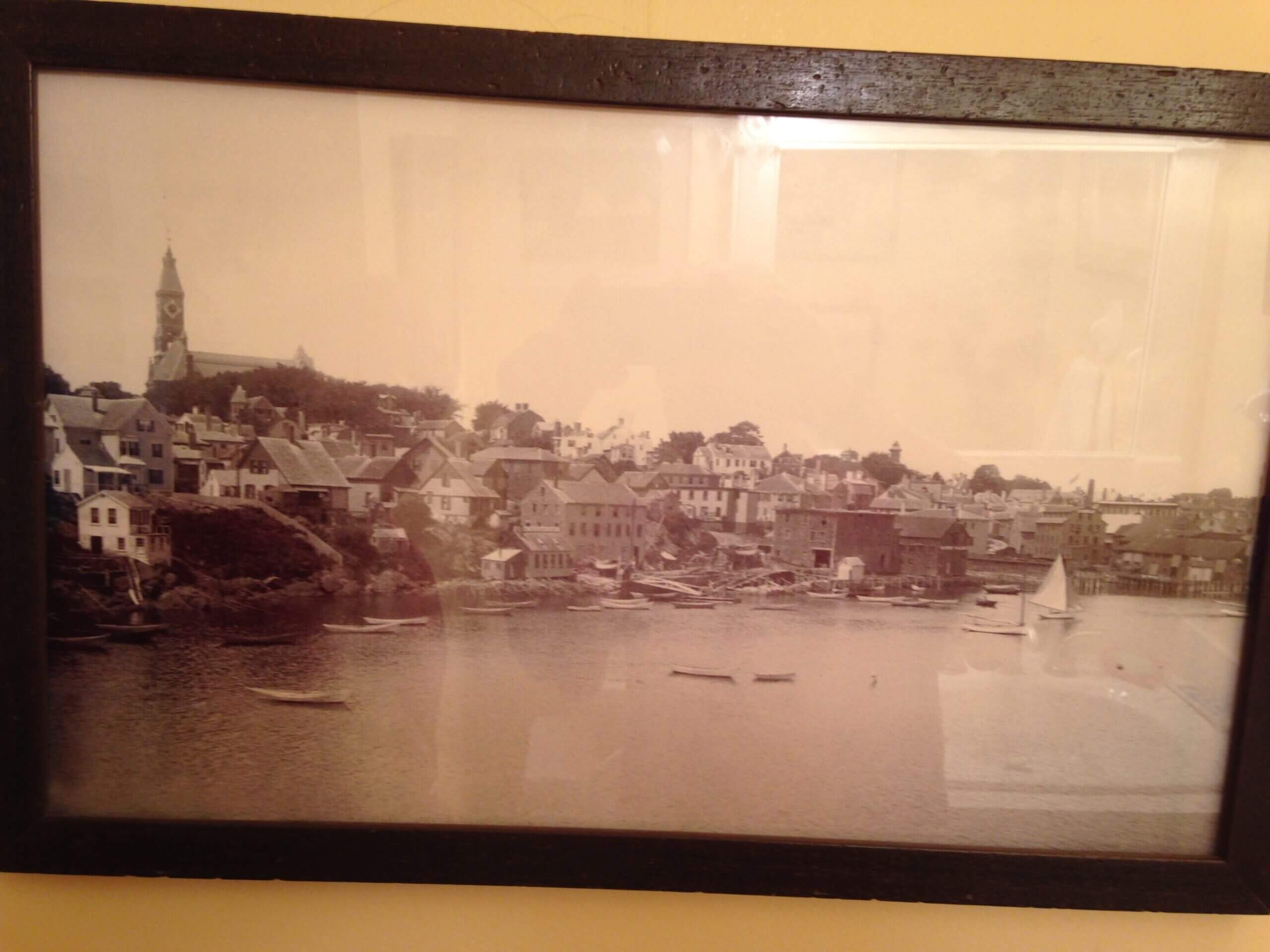
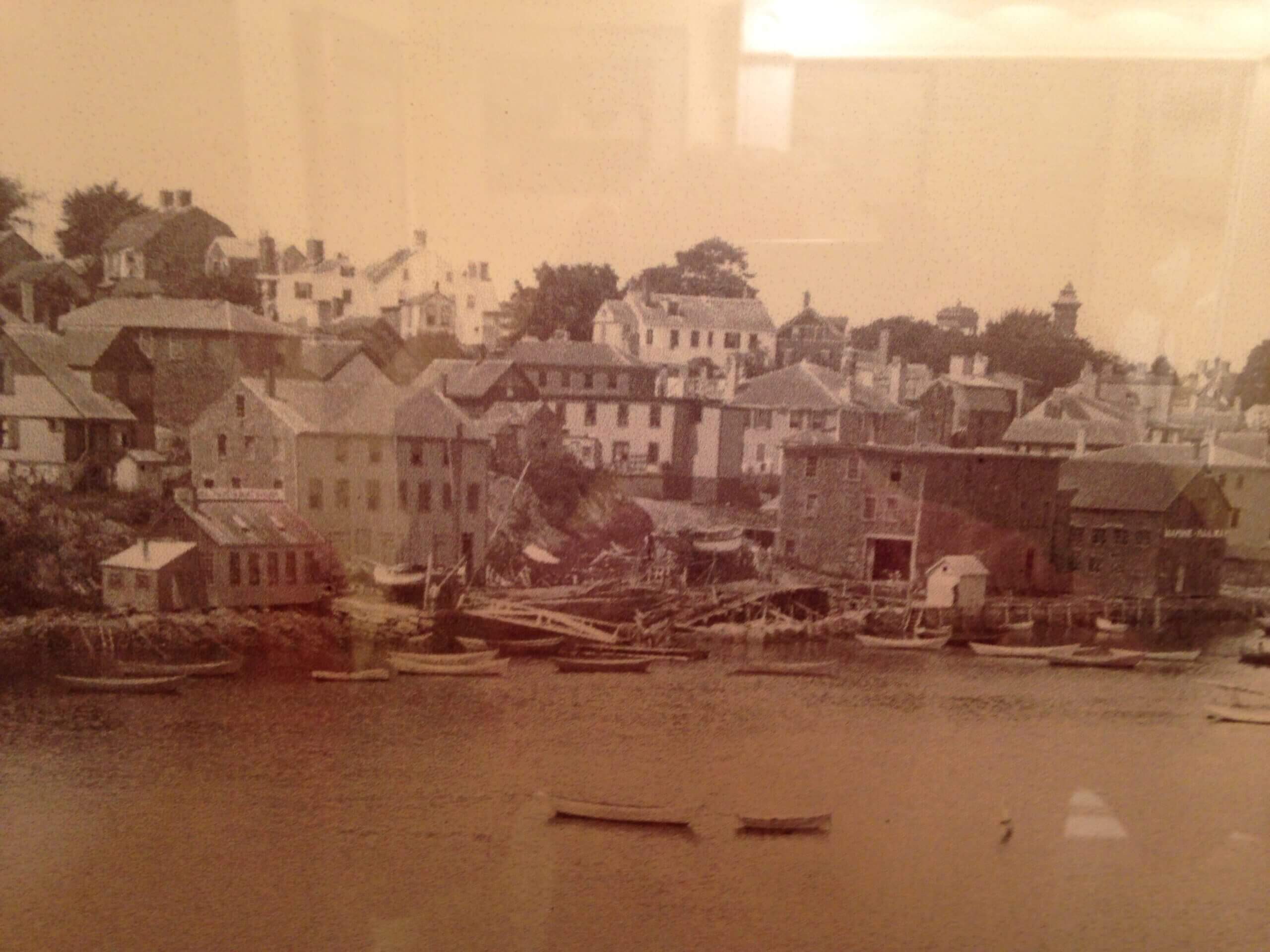
This property includes Col. Jeremiah Lee’s wharf and large warehouse built in 1754; it also includes a warehouse and wharf built in 1808 for Capt. Joseph Barker. Although the wharves are long gone, the warehouse frames, or parts thereof, are included in the structure of two of the buildings now being used as residences.
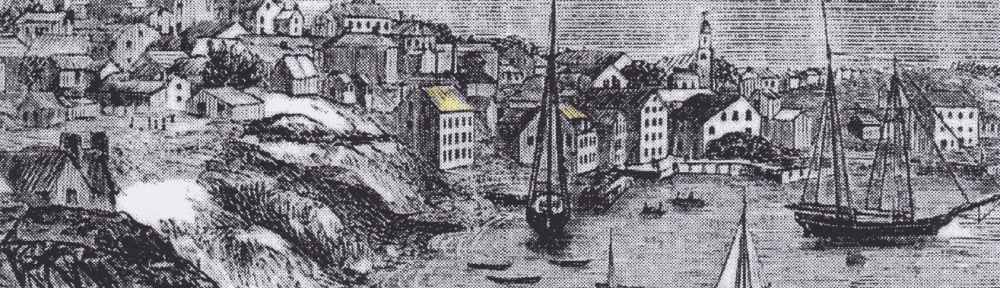
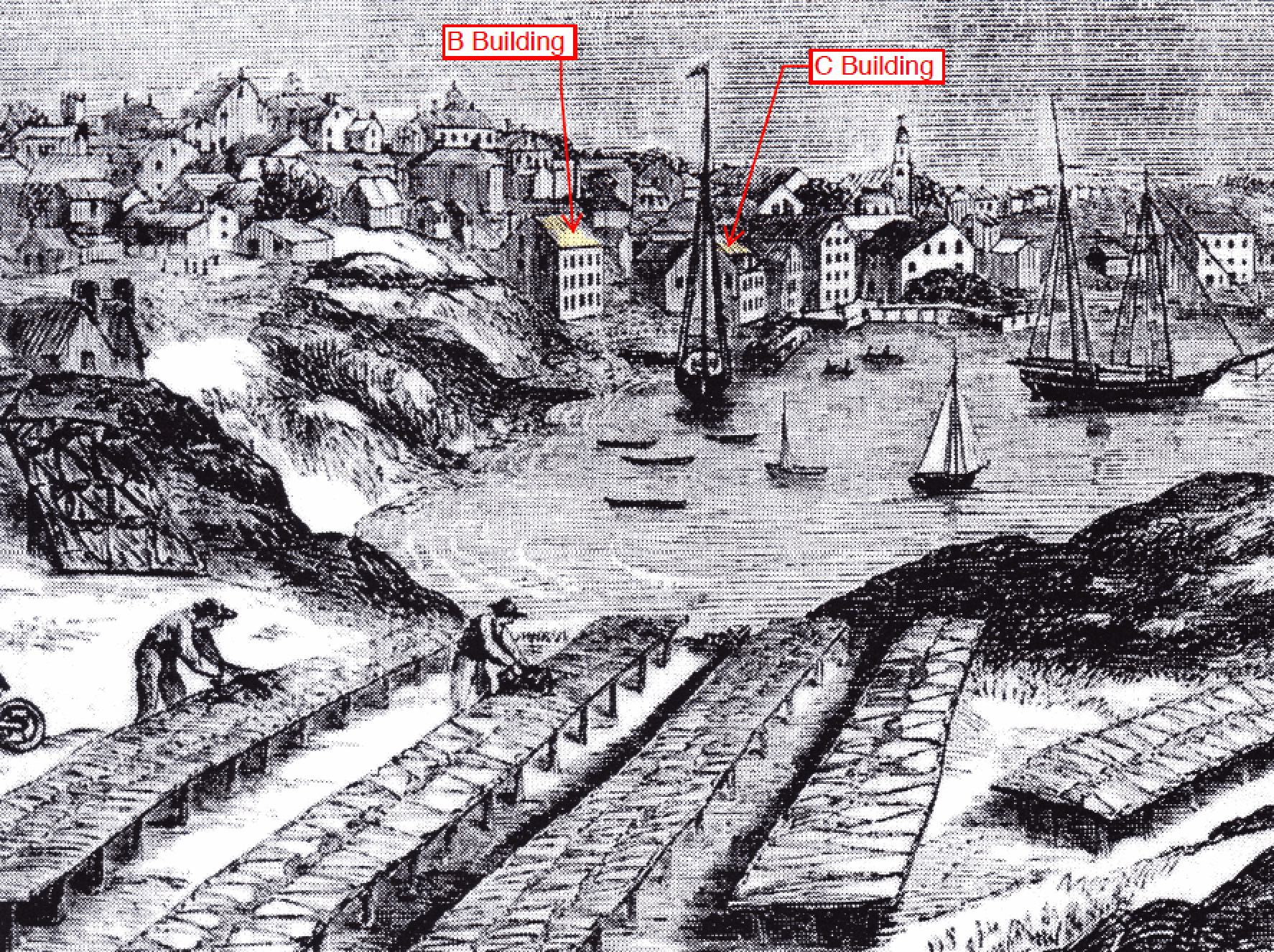
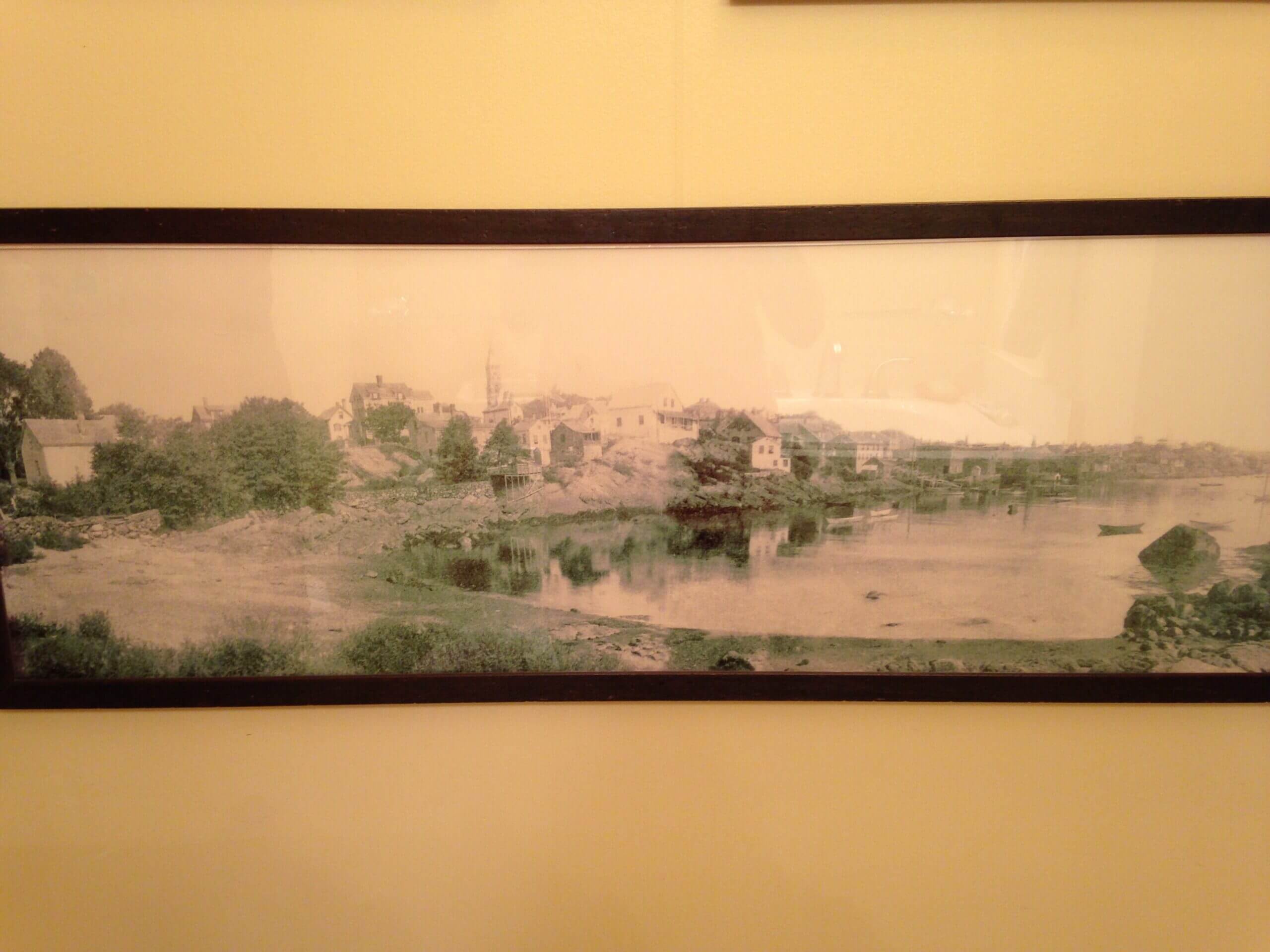
The appearance, perhaps original, of the two old buildings may be seen in the 1854 lithograph published in Gleason’s Pictorial (attached), a view from the fishyards of Skinner’s Point looking north along the harborfront, and depicting these buildings and their wharves as the first two to be seen beyond the ledges. This is the only known view that shows the Jeremiah Lee two-story warehouse with its original pitch roof (with dormers in the third-floor loft), the ridgeline of which ran southwest-northeast as did that of the 1808 three-story Barker Warehouse/Store. The next (third) building depicted along the shore was the warehouse of “Union Wharf” built in 1765 adjoining to Lee’s warehouse and wharf—the Union Wharf property (later the Hooper-Russell Wharf) is not part of the current premises.
Synopsis
Colonel Lee purchased a piece of land fronting about 120’ on now-Lee Street and about 120’ on the harbor, in 1754. He built a wharf and large store thereon. Lee owned it at his untimely death in May, 1775; and it remained in the family until sold in 1785 to James Swan of Dorchester. In 1798 Swan sold it to Capt. Joseph Barker, who acquired more land to the southwest, built a second wharf and a second warehouse, and had a cooper’s shop built to the west atop the ledge on Lee Street. The complex was well-known as Barker’s Wharf. Joseph Barker died 1817.
The property was then (1818) sold to John Sparhawk, who sold it 1821 to the Marblehead Bank. It was then known as The Bank Wharf. In 1834 the Bank sold it to John Traill, who kept the northeast part and in 1835 sold the southwest half to William Reed Esq. Reed, who already had a store on nearby Lee’s Wharf1, died shortly after. Reed’s heirs 1838 sold his part to Phares Shirley and John Quiner. In 1840 Shirley and Quiner made a divisional deed with John Traill. Two years later, in 1842-3, Traill sold out to them. For many years, 1840s, 1860s, the property was known as Quiner’s Wharf (s.w.) and Shirley’s Wharf (n.e.).
1 Site of BYC parking lot; see 5 June 1830 Mhd Register ad placed by Wm. Reed
The Shirley Wharf & Store was sold 1857 to Stephen P. Hathaway, who kept it seven years; in 1864 he sold out to William Humphreys Jr. and Eben S. Twisden. They kept it 17 years; and in 1881 they sold out to Henry A. Potter & Moses Gilbert (ED 1055:86). Potter already owned a big wharf off Cliff Street. Moses Gilbert became sole owner, and in 1900 he sold the same to John H. Frazier. 2
The Quiner Wharf & Store were sold 1865 to James Chapman, housewright, who used it as a lumber wharf, but lost it in legal proceedings. In 1866 it was sold to sailmaker Thomas Gilbert, who sold it 1870 to housewright George Hatch, who sold it in 1872 to housewright Benjamin G. Hathaway. Mr. Hathaway leased the waterfront section to James Billows, who operated a boatyard here. Mr. Hathaway kept it until 1899, when he sold most of it to John H. Frazier, boatbuilder, while reserving a piece on Lee Street to his son George G. Hathaway in 1903.
Jeremiah Lee Wharf, 1754
In January, 1754, Jeremiah Lee, merchant, purchased from the heirs (siblings) of Mrs. Susannah (Neck) Robinson, deceased, a parcel of land bounded northwest 120’ on the street, northeast on land assigned to Richard Neck and on land of Mary Collins heirs, southeast 120’ on the harbor, and southwest on land “formerly sold to Majorey” (ED 98:230, etc.). The grantors were Mrs. Alice (Neck) Burroughs, et al. This parcel was near the large cove where the Boston Yacht Club and its parking lot are today; that cove, known as Neck’s Cove, had become a commercial center in the 1720s.
Jeremiah Lee already co-owned a wharf nearby (he and his father had owned it, just southwest of Neck’s Cove). His father had died in July, 1753, and perhaps Jeremiah wished to have a wharf and store of his own, not connected to his ftaher’s estate. On his newly acquired parcel of 1754, Colonel Lee built a wharf and a large warehouse. The attic of the warehouse was used as a sail loft (leased as early as 1766 by Joseph Striker, sailmaker, of now-12 Mugford Street).
The warehouse had a wharf that extended at least 60’ along the southeast of the building. The wharf was perhaps set on pilings, or on stones. The southeast side of warehouse itself may have extended over the water on pilings. In those days, the harbor waters came in closer to Lee Street than they do now, after many alterations and in-filling along the shore. This was the wharf where all of Colonel Lee’s trading ships, brigs, and schooners were outfitted, where they were laden with their outgoing cargoes of fish, and where they were unloaded upon their arrivals from the ports of Europe and the Caribbean. It was probably also the place from which his fishing schooners were supplied and took their leave for the Grand Banks. It was one of the busiest places in Marblehead.
Colonel Lee, a native of Manchester who came to Marblehead when twenty-two, married Martha Swett, a local heiress. He became exceedingly prosperous in trade with Europe and the Caribbean: typically, the Marblehead cargoes were cured codfish (the “fast food” of the day), with lumber brought down from New Hampshire and Maine; and return cargoes were salt, wine, iron, fruit, textiles, cordage, and sail-cloth (“duck”) from Europe, and sugar, molasses, cocoa, mahogany, and coffee from the Caribbean. His ships carried his snow-white house-flag at their forepeaks.
In Marblehead, Jeremiah Lee was a prince of commerce; only his older brother-in-law, Robert “King” Hooper, was richer. Lee and his family resided at now-Two Union Street when this wharf and warehouse were built. In 1764 Colonel Lee decided to build a much larger mansion. In 1766 or 1767 the Lee family moved into their new mansion at now-161 Washington Street. In the 1760s Colonel Lee became a 3
leader of the rebel cause, and began preparing for war, not least in drilling his regiment of militia (when the men and boys were ashore from their fishing and trading voyages). He was a visible political leader, and served as chairman of the convention that issued the Essex Resolves to oppose the British. He also headed up the rebel effort to secure munitions from Europe and supplies from the tidewater, in case of war; in that role, he made many clandestine visits to the south. Lee’s efforts paid off handsomely: large quantities of Lee-acquired cannon, shot, and powder came to Massachusetts, and some was stashed at Barrett’s farm in Concord.
In October, 1774, the Massachusetts legislature, convened at Salem, declared itself independent of the Crown and adjourned to Concord. On the night of April 18, 1775, Colonel Lee and his Marblehead associates, Elbridge Gerry and Azor Orne, were staying at a Lexington tavern while serving as delegates to the rebel legislature at Concord. When the British soldiers marched out of Boston that night, the three Marbleheaders fled for their lives and hid in a field for several hours. Next day, the battles of Lexington and Concord took place. Colonel Lee fell severely ill afterward, and tried to recover at the Tracy farm in Newbury (the Lees’ daughter Mary had just married Nathaniel Tracy). Instead, he died on May 10, 1775, aged just 54 years. He was among the leading patriots in America, and would have played a very large role in the Revolution and, perhaps, in the formation of the new nation.
After Jeremiah Lee’s death, an inventory of his property was made in 1776. “His wharf and large store built by him westward of Neck’s Cove aforesaid and improved by him till the time of his decease, together with the land behind and adjoining said store and a blockmaker’s shop on said land lately improved by Daniel Glover,” were valued at 1100 li (versus the 3000 li value of the Jeremiah Lee homestead at now-161 Washington Street). Daniel Glover, blockmaker, of Mechanics Court, was a younger brother of Col. John Glover, who had taken over the leadership of Lee’s regiment. Colonel Lee had owned other nearby commercial property too, not so valuable. The inventory lists all of the items that were found in the store/warehouse in 1776. No doubt some of the goods had already been sold or removed; nevertheless, it gives an interesting picture of the retail and wholesale business of Jeremiah Lee on the eve of the Revolutionary war.
During the war, 1775-1783, most of the Lee vessels were stashed up the Merrimack River, and used primarily by the Tracys as Newburyport privateers. Jeremiah’s only adult son at the time, Capt. Joseph Lee, served in the army under Colonel Glover (later General Glover). Away from home much of the time, he was unable to manage his father’s property although it is likely that this was used as a privateering wharf. Marblehead suffered great hardship during the war, both in loss of life and loss of business; and it did not recover in the 1780s with the coming of peace. Joseph Lee, a Harvard graduate and would-be merchant who resided at Two Union Street, had a family of young children but no real post-war prospects; and it seems that his health had been wrecked by the privations of his military service.
The Jeremiah Lee property remained in the family, but the estate was headed for insolvency. The Tracys sold the wharf and warehouse in June, 1784, to Joseph Lee, Esq., Marblehead merchant, who sold it immediately to James Swan Esq. of Dorchester (ED 141:190). This latter sale may have been in the nature of a mortgage, but (if so) it was not redeemed. Joseph Lee died in 1785, aged just 37 years. 4
James Swan, the owner, held the former Lee property for some years, during which the wharf and store must have been leased by some merchant(s). He sold a piece of the premises in 1797 to James Bowler (of now-20-22 Lee Street), bounded 47.5’ on Lee Street next to Bowler’s house (ED 161:287). In March, 1798, James Swan for $2800 sold to mariner Joseph Barker various pieces of former Lee property, including this land and “any wharves, stores, and fences thereon,” bounded 93’ on the street to the fish fences, southwest 72’ on land of William Neck, 20’ northwest on ditto, southwest on land of Majory’s heirs, southeast on the Harbour, and northeast on land and stores of various owners and on land of “Boler” (ED 163:81).
Joseph Barker’s Wharf
Capt. Joseph Barker (1760-1817) resided in the mansion, now-217 Washington Street, and was president of the brand-new Marblehead Bank in 1804, when it acquired the Jeremiah Lee mansion for $5,000 to serve as its quarters. Barker was the son of Joseph Barker and Hannah Hooper; he had been a teenaged privateering deckhand in the Revolutionary War; afterward, he had married Mary Bubier of Marblehead; and he had sailed in command of vessels in the foreign trade: 143-ton brigantine Nancy, 107-ton brigantine Hope, schooners Peacock (to Bilbao in 1795 and 1797 and in 1798, when he became owner of that vessel) and Molly in the 1790s.2
2 See MFC, various citations; also B.J. Lindsey, p. 9
3 See MFC various citations. Also, Ashley Bowen shows a house-flag for “J. Barker”, plate XXXVI, but does not indicate its colors and markings; see volume II, P.C. F. Smith, editor, The Journals of Ashley Bowen. Bowen was a ship-rigger by trade, and probably worked in the sail-loft here, since Jeremiah Lee employed him.
He retired from the sea to become a merchant c.1799, and began serving as a selectman. He owned the 74-ton schooner Hannah starting in that year, and employed her (under Capt. George Barker) in trade with Lisbon (return cargo: salt, lemons, oranges, wine, feathers, and hides). By 1800 he was co-owner of the same with William Hooper, and employed her under Capt. John Hooper in trade with the West Indies (coffee, sugar, molasses). He and John Hooper took in Bostonian Theodore Lyman as co-owner of the 71-ton schooner Betsey in 1800, and employed her under Capt. George Barker in a voyage to Hamburg (return cargo: glassware, linen, silk gloves and stockings, Russia duck cloth for sail-making, stout, and bar iron). He traded to Hamburg, Havana, Haiti, Gothenburg (Sweden), and St. Bart’s in 1801-1802. In 1802 he and John Candler purchased the 74-ton schooner Yarico and engaged her in trade with Nantes (France) under Capt. John Cloutman (return cargo: salt, cordials, Bordeaux wine).3
Captain Barker evidently made a specialty of importing French wines thereafter (per his advertisements). He was prominent in town politics, was elected selectman, and then served as a state legislator. He was a partisan Democratic-Republican (Jeffersonian), which was the dominant party in Marblehead (but not elsewhere in Massachusetts). 5
In October, 1799, Samuel Sewall Esq. for $27 sold to Joseph Barker, mariner, a small parcel, 24’ wide, bounded northeast on land, wharf, cove formerly of Jeremiah Lee, southeast on the harbor, southwest on Majorey’s heirs, northwest on land formerly of William Neck (ED 167:64). Note: Sewall had bought this Nov. 1793 from the Joseph Striker estate (ED 157:206, parcel bounded as 167:64).
Joseph Barker bought other land hereabouts, that now constitutes part of the modern premises, in 1802, from the heirs/assigns of Joseph Majory:
June 1802: William Bowen, mariner, to Joseph Barker, merchant, moiety (undivided half) of part of the Bowler fish fence formerly of Joseph Majorey bounded etc., subject to right of Mrs. Abigail Stevens… (ED 171:57).
July 1802: John Stevens, shoreman, and wife Abigail for $13 to Joseph Barker merchant, her right in land & rocks bounded northwest 6’ on way to fish fences, etc. (ED 171:57).
Sept. 1802” Sarah Hathaway, Machias widow, $60, to Joseph Barker, merchant, moiety of land & rocks of her grandfather Joseph Majorey, bounded northwest on the road to the fish fences, northeast on house & land of Wm. Shirley, southeast on the harbor, and southwest on land & rocks of James Bowler, subject to the right of the wife of John Stevens (ED 171:58).
In June, 1805, and June, 1806, Captain Barker bought more land that had formerly been the property of Joseph Majorey:
June 1805 James Bowler $150 to Joseph Barker, land adjoining the westerly part of Barker’s new wharf, bounded (etc.) (ED 175:304).
June 1806 James Bowler $50 to Joseph Barker, a triangular piece adjoining on the southwest side of the piece sold in 1805, bounded (etc.) (ED 178:260).
The new wharf (formed by extending a pier southerly into the harbor) was built in 1808, at the south corner of the premises, with a new warehouse above it. This gave Barker two wharves and two warehouses. It is not known what happened to the Glover blockmaker’s shop (see Lee inventory), but Barker also built a cooper’s shop (or moved the blockmaker’s shop) on the rocks above, facing on now-Lee Street.
Capt. Joseph Barker, a widower, was among the most prominent and affluent men in the town. In July, 1810, the Salem minister, William Bentley, was a guest at a fish-fry on the Neck. “Captain Barker, our intended senator, and Captain Girdler joined us … and gave us a sail in the afternoon.” Bentley noted that “Captain Barker just below Skinner’s Head has a pier which, with bars at the western end, encloses a basin sufficient to for several vessels which lay perfectly secure within common fasts. This is the second year since it was raised. It is well built.”4
4 11 July 1810 diary entry, Rev. William Bentley.
It was very difficult to make money in foreign trade beginning in 1808, with a one-year Great Embargo on all such trade, followed in 1809 by a period of trade in which American shipping was harassed by the British and sometimes impounded by the French (France and Britain were engaged in a world war). At some point, one of Captain Barker’s vessels (and cargo) was impounded at Sweden, probably by the French. This severely damaged his business. Trade was suspended during the War of 6
1812-15, which prevented Captain Barker from getting a return on his assets. In 1815, too, his beloved daughter Sally died, aged twenty-two. In 1816 trade was renewed, but Capt. Joseph Barker had long been ill, and on April 27, 1817, he died. He had not had a chance to recoup his fortune, and so left almost nothing to his four children, three of whom were teenagers, one, Joseph Jr., being only thirteen.
Mr. Bentley memorialized him in his diary. “Esquire Prince sent me word that Capt. Joseph Barker died yesterday, aet. 57. He was a man of excellent mind and had obtained a great property, but the seizure of his vessel in Sweden and the events of the war reduced his property very much. He built, in the upper part of Marblehead, a pier which guarded his vessels from the dangers of that exposed harbor, and was the first who distinguished himself in that way. I felt greatly indebted to him for his hospitality. He was President of Marblehead Bank.” On May 1, Bentley noted, “At Joseph Barker’s funeral in Marblehead, everything was respectful which a long procession and the expression of general esteem could supply. But four children, two of each sex, immediately after a corpse, without parents and by advance events without patrimony, was not a sight for the tender-hearted. Ought not these children to have been led by their kindred? He was lodged in the Barker ground near the Powder House.” He reflected also on the death of an esteemed Salem woman and her funeral; “but the undissembled sincerity of Marblehead” (in the event of Captain Barker’s funeral) “had the deeper interest and defied a representation.”
In February, 1818, the Barker estate for $4,450 sold to John Sparhawk, gentleman, the stores and wharf, with the land and rocks here (ED 219:55), along with the cooper’s shop and its land and rocks fronting 88’ on Lee Street (street leading to the fish fences) (ED 217:1).
The Bank Wharf
In December, 1821, John Sparhawk (wife Emma), gentleman, for $4,450 sold to Marblehead Bank the wharf and stores that he had bought from administrator G. Barker (ED 229:56). Thereafter, it was known as “The Bank Wharf.”5
5 It is so called on 5 June 1830 in the Marblehead Register newspaper in the advertisement of the
sale of the property of James Bowler, deceased, including “The Fish Fence Lot, so called, near to
William Gardner’s and adjoining the Bank Wharf with two buildings thereon”.
In September, 1834, for $2500 the Marblehead Bank sold the premises to John Traill Esq. (ED 281:28). He was a Marblehead merchant residing at Six Union Street. He had been engaged in foreign trade in the 1820s, but by the 1830s it appears that he had gone into the fish business, with ownership of three fishing schooners. A few months later, Traill for $1350 sold to William Reed Esq. “the old store” on Barker’s Wharf, and reserved to himself (Traill) the “new store” to the west (“new” was a relative term). Reed’s land was described as fronting southeast 65’ on a line that was 5’ distant from the building thereon, southwest 57’ on the common way, northwest 74’ on the way behind the store, and northeast 62’ on Hooper’s store and land. 7
Messrs. Traill and Reed were to have equal moieties of the wharf, dock, and land (ED 281:29).
William Reed died 1837. On 7 May 1838 for $1600 the executors of his will sold his premises here to John Quiner and Phares Shirley (ED 305:178).
This gave Traill (southwest part), and Quiner & Shirley (northeast part) ownership of the wharf and stores here. They decided to make a division and to lay out a common road to their property from Lee Street (ED 319:117); and in June 1840 John Traill sold to J. Quiner and P. Shirley his right in the land and wharf formerly of Joseph Barker southeast of the new common road, together with half the dock being the southeast part from the center of the headway of the dock southwesterly to the entrance or passageway of said dock in common for both wharves (ED 319:117).
In January, 1842, John Traill mortgaged to Marblehead Bank his wharf and store as in the June, 1840, divisional deed, along with other real estate (ED 329:24). But Traill was in financial trouble, and in May 1842 John Traill’s assignees for $710 sold to John Quiner and Phares Shirley their right to land, store, and half wharf off Lee Street (ED 331:237). As an afterthought, in January, 1843, John Traill sold Quiner & Shirley whatever right he still had to the land, wharf, and store that his assignees had already sold to them (ED 340:106).
This gave Quiner and Shirley ownership (1842) of the whole of the Jeremiah Lee and Joseph Barker wharves, stores, and land. Quiner and Shirley decided to divide the property. In July 1842 John Quiner sold to Phares Shirley the easterly part of the premises, with wharf and warehouse thereon, per a plan that they recorded with the deed record (ED 332:191).
Sketch of site, appended to 1842 agreement of Shirley and Quiner, deed 332:191 8
Shortly afterward, the old Union Wharf (Hooper-Russell’s) to the northeast was purchased by housewright Benjamin G. Hathaway (note: many years later it was sold to a Quiner, which provides a new layer of confusion in that there were, historically, two Quiner’s Wharves and two Hathaway’s Wharves along the same stretch of harborfront at various times—here and at the “Union Wharf” site to the northeast of the Jeremiah Lee Wharf).
Quiner’s Wharf (southwest)
After John Quiner sold to Phares Shirley in 1842 the northeasterly wharf and store (ED 332:191), Captain Quiner kept the southwestern wharf and store for himself, and operated them for twenty years.
John Quiner had been a shipmaster in foreign trade. In 1829 he had retired from the sea and built a handsome house on Pleasant Street; and he prospered thereafter as a merchant, importing materials from overseas and landing them here at his wharf and store.
The Quiner Wharf & Store were sold on Sept. 11, 1865, to James Chapman, housewright, who used the property as a lumber wharf (ED 695:54). Chapman, who resided at 58 Lee Street, started building a house on the upland along Lee Street; sadly, he went bankrupt in the spring of 1866, and had to sell his property. In July, 1866, for $1800 the store, wharf, and land were sold to sailmaker Thomas Gilbert, along with the unfinished house on Lee Street and all of the lumber, finishing stock, and other materials :lying and being” on the premises (ED 707:277). Immediately, Mr. Gilbert sold the unfinished house and its land and ledge to William Stone and others (ED 2674:469). The rest of the premises he retained until August, 1870, when he sold them for $1300 to George Hatch (ED 804:262).
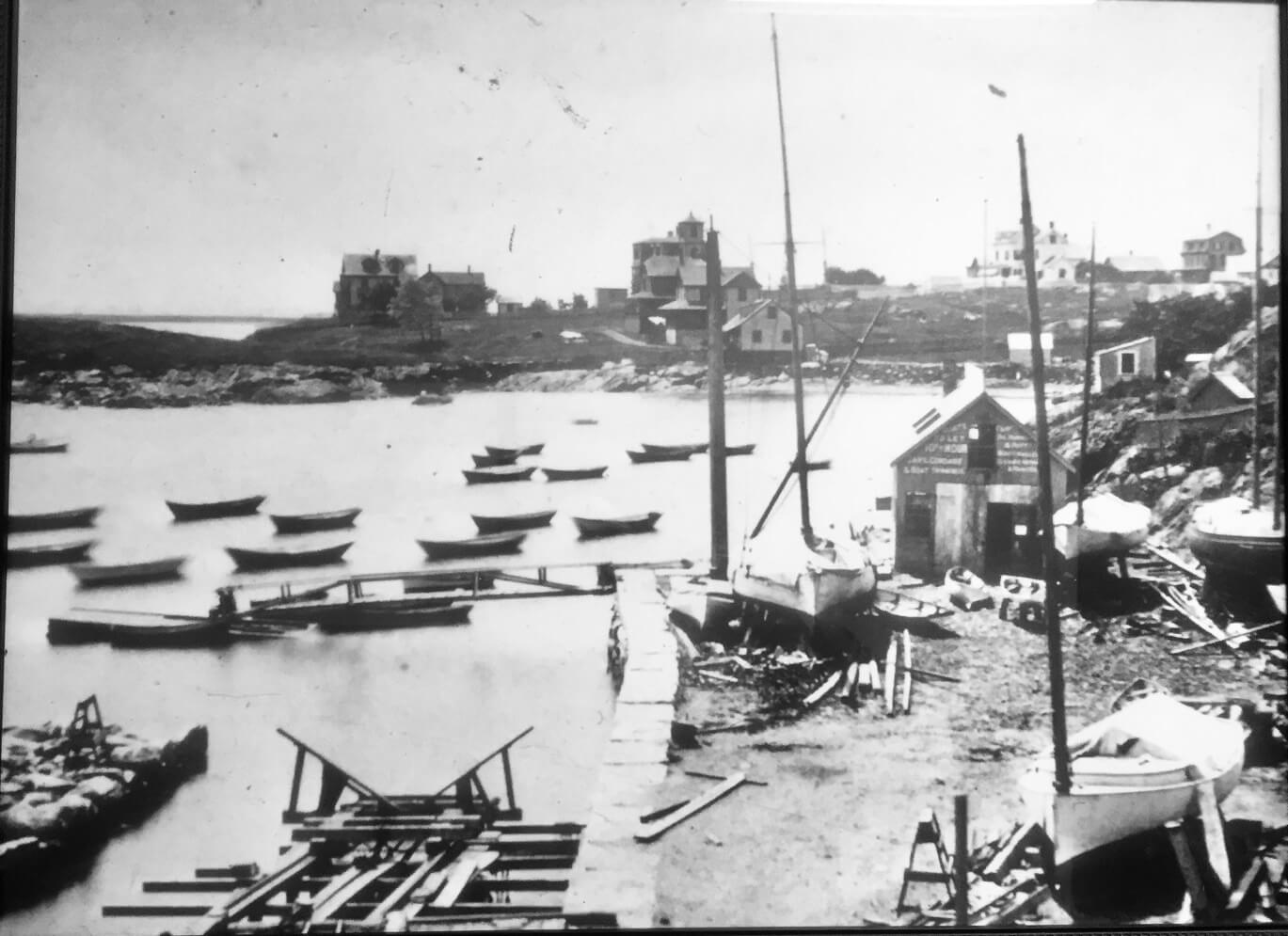
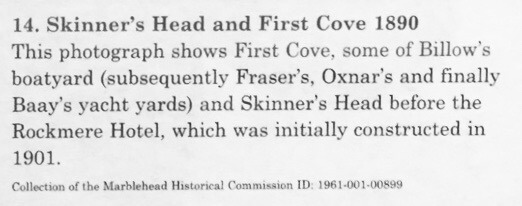
Two years later, in September, 1872, George Hatch for $1500 sold the wharf, store, and land to housewright Benjamin G. Hathaway (ED 908:214), the man who had formerly owned the Hooper-Russell wharf to the northeast. Mr. Hathaway would operate this as his lumber wharf for some years, and then would lease it (or part of it) to James Billows, who had his boatyard here. Mr. Billows had a marine railway, and had a business in building sailing yachts as well as power boats, as well as boat storage in the off-season. Mr. Billows in 1884 was identified as a boat-builder residing on Lee Street, near Tucker. His boatyard was well-known, and evidently popular with the yachting set; many photographs were taken of it during its two decades of operation.
This southwesterly part of the premises was known as Hathaway’s Wharf, and was the lumber yard and carpenter’s shop for Benjamin G. Hathaway, a long-time Marblehead builder who lived just over the line in Salem, in the large Victorian Queen Anne-style house that he had built at the head of Salem Harbor (still standing).
By 1881 (per atlas) Mr. Hathaway had added a large ell to the northeast side of the old Barker Warehouse. However, between 1897 (ell still there, per atlas) and 1912 (per atlas) the northeast part of the building had evidently been removed, perhaps due to fire (some of the remaining early frame is scorched). Note: the northeasterly part of the present large building was added in 1929 by John H. Frazier. 9
In January, 1899, Mr. B.G. Hathaway received a license to extend and maintain a marine railway here (see Mass. Harbors & Lands Commission records, p. 58, Jan. 1899). In August, 1899, B. G. Hathaway sold his property to John H. Frazier (ED 1586:59), including the part that was. This was the part that had been Billows Boatyard. It thus became Frazier’s Boatyard. Mr. Hathaway retained a small piece of the premises, up on Lee Street, for some years more; and in August, 1903, he sold the remainder to his son George G. Hathaway (ED 1748:313).
John H. Frazier retained the property and operated the boatyard for three decades and longer. He added a new marine railway, evidently in front of or in place of the old Lee Wharf, on the eastern corner of the premises against the harbor, in September, 1906 (see Mass. Harbors & Lands Commission records, p. 64, 14 Sept. 1906; also, ED 1887:503).
Shirley’s Wharf (northeast)
Capt. Phares Shirley owned the “northeast” wharf and warehouse during the years 1842-1855. A retired shipmaster, he resided on Summer Street and worked as a merchant. He had grown up in the house on Lee Street, owned by his father, sailmaker William Shirley, who had come to Marblehead as a poor boy from Boston. Phares Shirley died_in 1855, having willed his property to his three children.
In October, 1855, Mrs. Mary (Shirley) Bruce sold her interest to her brothers Phares Shirley (Jr.) and Wm. Henry Shirley. The land was bounded southeast on Marblehead Harbor, southwest on John Quiner’s land & wharf, northwest on Lee St, and northeast on B. G. Hathaway’s land & wharf and also on land of Bacheller (ED 520:112). Note: B.G. Hathaway would later become owner of the Quiner Wharf & Warehouse, but in 1855 he owned the wharf & warehouse (formerly Hooper-Russell’s) to the northeast of the premises here.
In November, 1857, the Shirley brothers sold to Stephen P. Hathaway the wharf, warehouse, and land of their late father (ED 562:2). Mr. S. P. Hathaway owned it for even years and in 1864 sold it to coal-dealers William Humphreys Jr. and Ebenezer S. Twisden (ED 663:13). Humphrey & Twisden did a large business in coal and fuel, and had another wharf close by. In 1881 they sold this property to Henry A. Potter & Moses Gilbert (ED 1055:86). Potter & Gilbert were partners as lumber dealers and in the box-making and heel-making businesses; and they would come to own another wharf and factories in the Shipyard, off Cliff Street. In 1884 their operation here was Potter, Gilbert & Sons (John L. Gilbert & William B. Potter), and Moses Gilbert resided in a nice house on ocean Street while Henry A. Potter, 65, lived in a house on Cliff Street.
In March, 1888, Henry A. Potter sold out his interest in the premises to his partner Moses Gilbert (ED 1218:555). Twelve years later, on 10 October 1900, Moses Gilbert sold to John H. Frazier, a parcel of land and wharf with
the buildings, formerly Shirley’s Wharf, bounded southeast on the Harbor, northeast on land & wharf of Quiner and on land of Sumner formerly of Bacheller, northwest on Lee St, and southwest on land of Hathaway & of Frazier (ED 1623:341). Mr. 10
Gilbert (1825-1903) retained a small piece of land with buildings, bounded northeast on land of Sumner, southeast on a line 9’ parallel to the southeast end of the building on said lot, southwest on a roadway leading from Lee Street to said wharf and to wharf of said Frazier, and northwest on Lee Street; and he gave Frazier a right-of-way over that part of his (MG’s) land lying between the southeast side of the building thereon and the roadway to his buildings in the rear of said land (ED 1623:341). His widow later sold it to Mr. Frazier in July, 1906 (ED 1833:299), Mr. Gilbert having died in November, 1903. Mr. Gilbert’s son, John Long Gilbert, organized the firm of Gilbert & Cole, lumber dealers, still going strong on Bessom Street.
As has been mentioned, John H. Frazier (1859-1934), who had now consolidated the two parcels (formerly of John Quiner and of Phares Shirley) ran a boat yard here. He was a native of Bath, Maine, where he learned the trade of a shipwright; and he had gone to sea several voyages as a ship’s carpenter. In Marblehead he was highly respected as a businessman although “somewhat eccentric” and not particularly sociable. He did not marry. His best friends were the men who worked for him and the yachtsmen who did business with him (per obituary, Mhd. Messenger, 12 Oct. 1934). He added buildings to the premises (all those “new buildings” are now gone).
After many years had passed, John H. Frazier, who then resided at 27 High Street, put the property through Land Court on 25 January 1929 (ED 2792:482). At that time a plan was made of the premises, showing that the upper store (Joseph Barker’s) had not been given the large northeastern addition that it has today. Mr. Frazier must have built on soon, likely in the year 1929, in connection with his boatyard: his new addition nearly doubled the size of that building. He built boats and yachts, mainly sailboats, and made repairs, and also stored boats in the off-season.
In July 1929 Mr. Frazier sold some of the land (two small parcels) to Miss Susan M. Borden, who owned the adjoining property on Lee Street (ED 2810:546). Then he put up a huge metal shed that blocked the views of the nearby houses and caused a furor. He put up another such building, smaller, too (see newspaper article).
John H. Frazier, having moved to Swampscott, died of a heart attack in Lynn on 7 October 1934, at 75, a wealthy man. At his funeral, the pall-bearers were workmen from his boatyard: Ralph Buswell, Eugene Morris, Fred Mills, William Witham, Daniel Grant, and Archie O’Neil. Eventually Mr. O’Neil, a genial and popular figure in Marblehead, would operate a successful fish market on Washington Street, near the Old Town House, into the 1960s.
The executor of Mr. Frazier’s will was the Merchants National Bank of Salem. The Bank leased out the premises, with lawyer Luke Colbert of Marblehead, a friend of Mr. Frazier, serving as special administrator to operate the business. In July, 1935, the Bank agreed with the abutter, Miss Susan Borden, regarding her use of a float and its use of the marine railway, which was extended farther out into the water. This was the Great Depression, and yachting was on the wane.
In June, 1950, the Bank sold the premises (land, four framed buildings, two metal buildings, machinery and equipment, and marine railway at 24••• Lee Street) for $29,500 to Walter A. Conway of Marblehead, who immediately conveyed the same to Henry V. L. Baay. The property was bounded northeast on land now/formerly of 11
Sumner and of Quiner, southeast on the harbor, southwest on now/formerly Borden land, and northwest on various owners’ lots 169.12’ and on Lee Street 50.19’.
The new owner, Mr. Baay, was an energetic Holland-born yacht-yard operator who had been in Marblehead since the 1930s. Earlier, he had leased the waterfront property adjoining to the northeast of this for “boat and engine repair” (the old Union Wharf property; see photos by Samuel Chamberlain); and he had run a boat yard at Little Harbor, where he had carried out significant dredging and building of sea walls. He was a hearty, enterprising businessman, well-known for his abilities among the yachting set in the Northeast. He would later write a book about his experiences with yacht yards, Boats, Boat Yards, and Yachtsmen.
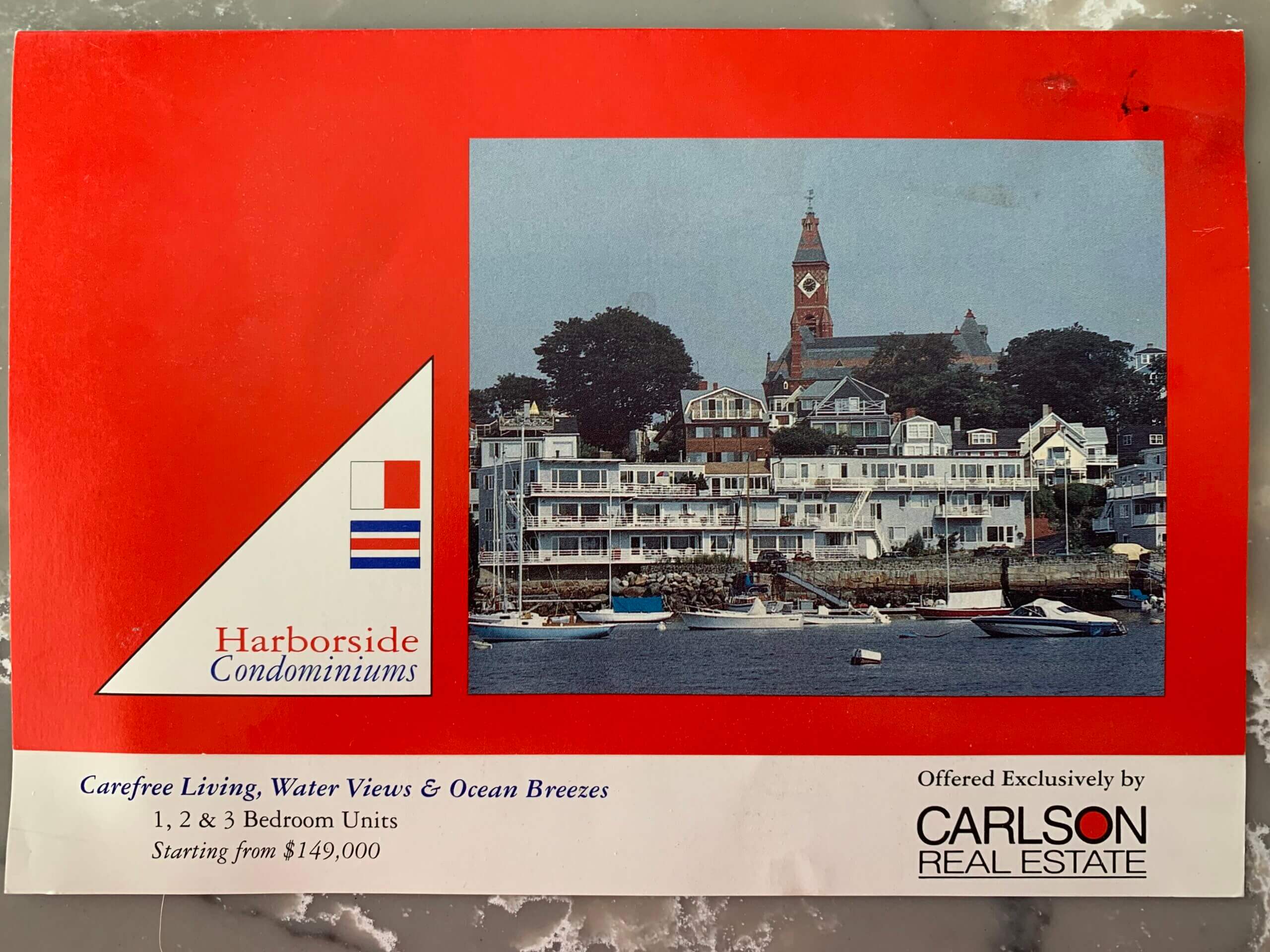
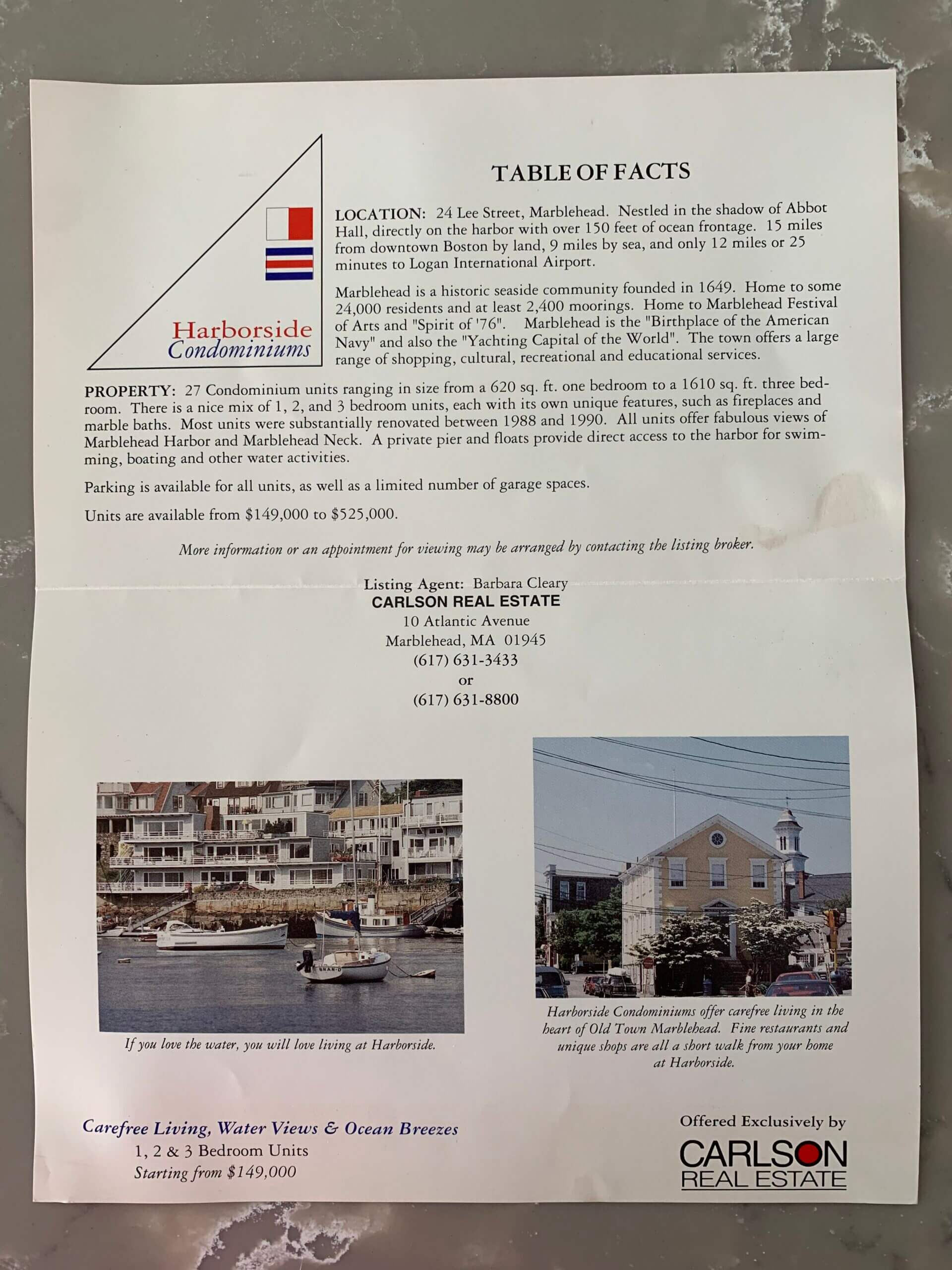
Mr. Baay had a boatyard here for years. Eventually, he renovated the old large framed buildings and converted them into apartments, filled in the southwestern marine railway, and built a new building close to the harbor, also used for apartments. He resided, for many years, in the pent-house suite of the first building to the southwest as one comes in from Lee Street, now known as Building B.
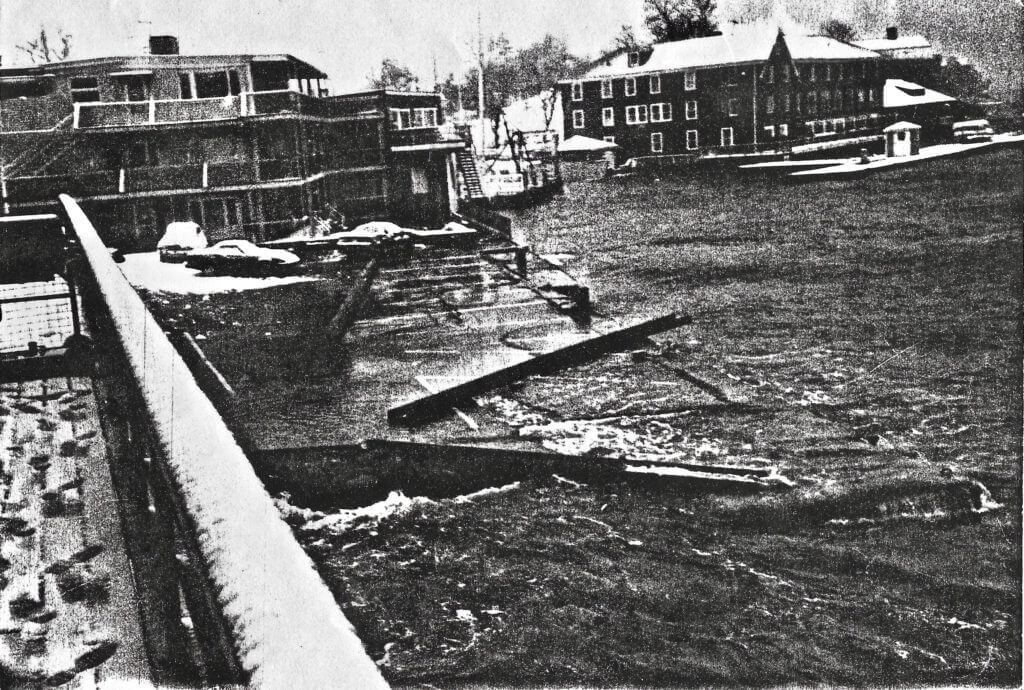
In 1981 the premises were converted from apartment to condominiums, as they remain today. The fire of October, 2013, badly damaged sections of Building B, but renovations are under way and the building will soon be completely restored to its use as residences.
—June, 2014, Robert A. Booth, Jr.
On August 30, 2015 Bob sent this additional historical information.
I wanted you to know that I had found a reference in the old Marblehead newspaper to the “original” fire in the Barker warehouse building (the one that was burned two years ago). As you know, the timbers were scorched from a much earlier fire, evidently one that took place c.1870.
The Messenger for 6 Dec. 1878 reports that “Benjamin Hathaway is repairing the building on his wharf which was partially burned several years ago. A new roof has been put on, and several alterations will be made. The lower part will be used for fish houses, and the second story will be let for storage. The part occupied by John Keating as a workshop has been enlarged and will admit of his building boats under cover.”
PDF Version: